
KEY SERVICE LINE
Audit & Recovery
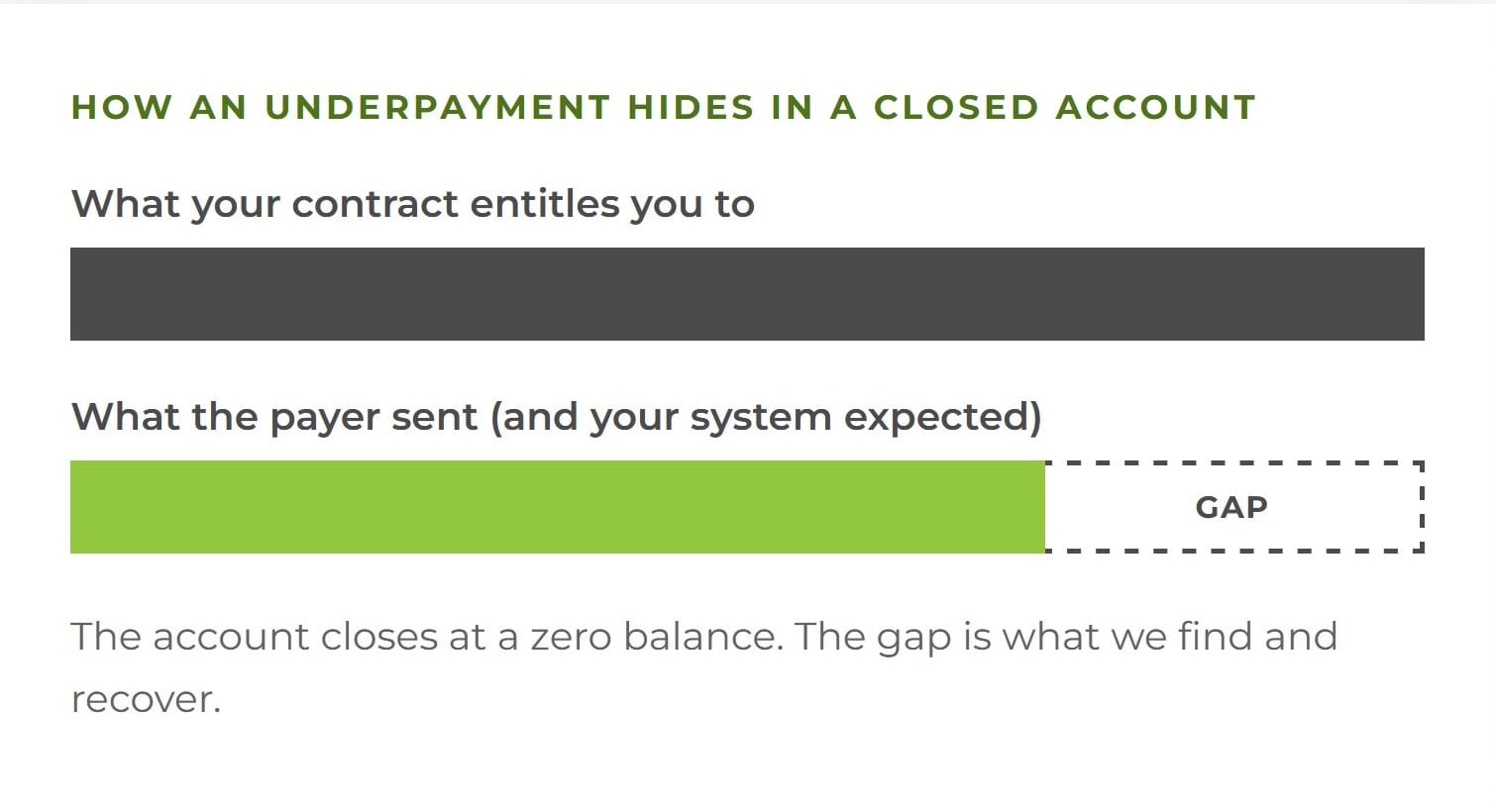
A zero-balance account means the payment matched what your system expected, which may differ from what you were owed. If your contract entitled you to more and the payer sent less, the account still closes, and nothing looks wrong. Most audit tools never catch that gap, which is where our audit and recovery service is built to work.


Proprietary Software, Hands-On Audits
We combine proprietary software with hands-on billing and coding audits to re-model closed accounts against your actual payer contract terms, surfacing underpayments that automated tools alone tend to miss.
Why Zero-Balance Underpayments Matter
Underpayments happen quietly, often through outdated fee schedules, incorrect DRG or APC weighting, or gaps in contract modeling that let a payer pay less than what’s owed without triggering a flag.
On already-thin margins, that adds up, and it’s revenue you’ve already earned but never received.
How We Find What Others Miss
A hospital closes tens of thousands of accounts a year, more than manual review alone can cover with any accuracy. Our proprietary software re-models each account against your actual contract terms and flags where the payment fell short.
That lets us look at the full zero-balance population instead of a sample, and it means our auditors can spend their time on the discrepancies that need expert judgment rather than sifting through accounts that paid correctly.
Broader recovery
We review the full account population rather than a sample.
A reasonable cost to collect
Automation handles the volume and our team focuses on the accounts worth the closer look.
Timely resolution
Corrected claims and appeals filed before filing deadlines close.
Flexible scope
A specific payer, a defined timeframe, or a particular account population.
How an Engagement Works
01
Pull closed accounts
We start by pulling historical accounts your hospital has closed over roughly the past one to two years.
02
Re-model every payment
Our software re-models the expected payment on each one against your actual contract terms and flags where the payment received came up short.
03
Audit the variances
Our auditors review the higher-value variances to confirm the cause and build the case for recovery.
04
Recover and report
We file corrected claims or appeals to bring the funds back, along with a report on what caused the underpayment, so it’s less likely to happen again.
Ready to recover missed revenue??
If your zero-balance accounts have never been audited against your actual contract terms, there’s a good chance revenue is sitting there unrecovered. Contact c3 Revenue Cycle Solutions to find out.
Frequently Asked Questions
What is audit and recovery in healthcare RCM?
It’s the process of reviewing closed hospital accounts to find underpayments and recover the funds: re-modeling accounts against actual payer contract terms, flagging shortfalls, and filing corrected claims or appeals to collect the difference.
What is a zero-balance account population?
It’s the group of accounts that have already been paid and closed to a zero balance. A zero balance means the payment matched what the system expected, not always what the contract owed, which is why these accounts often hide underpayments.
How is this different from automated underpayment software alone?
Automated software tends to catch simple, obvious errors. Our software re-models the full account population and flags every variance, and our billing and coding audits dig into the more complex, higher-dollar discrepancies that automation alone tends to miss.
Will this disrupt our internal team?
No. The service runs on historical, already-closed accounts and uses automation to handle the volume, so it runs alongside your existing operations rather than pulling your team into manual review.
How is the service deployed?
Flexibly. We can apply audit and recovery to a specific payer group, timeframe, or account population, depending on where you expect the most recovery.
What do we receive at the end of an engagement?
Recovered funds from corrected claims and appeals, along with reporting on what caused the underpayments, so you have a clearer path to preventing the same issues going forward.